
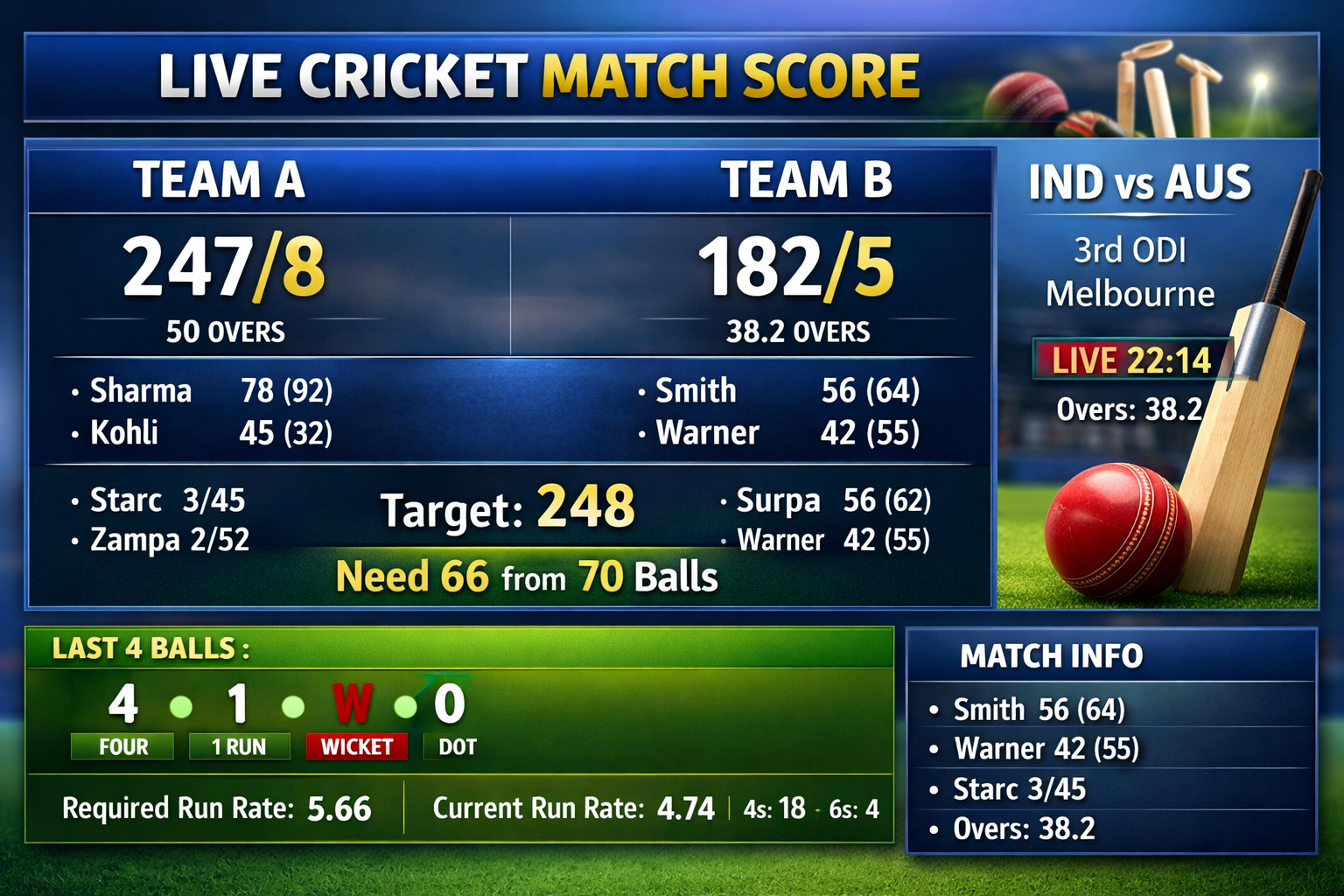
Cricket Match Score — How Live Updates Work in Real Time
The cricket match score is more than just numbers on a screen — it represents every ball bowled, every run scored, and every historic moment unfolding in real time. Today, millions of fans rely on a live to stay connected with the game, whether they’re inside a stadium, at home, or traveling across the world.
Real-time updates are powered by smart technology, scoring software, human scorers, data servers, APIs, and synchronized broadcasting systems. Behind every score update you see, there exists a complex ecosystem that captures, verifies, processes, and transmits match data within seconds.
In this detailed guide, we’ll explore exactly how the reaches fans instantly — from the scorer’s device to the cloud, and from there to apps, websites, and live broadcasts.
Why Real-Time Matters for Fans
The allows fans to follow the game ball-by-ball, even when they are unable to watch the match live. Real-time scoring enhances engagement, emotion, and excitement.
Short, crisp paragraphs provide better readability — especially on mobile screens.
Fans depend on the cricket match score to:
Track runs, wickets, partnerships, and required run-rate
Follow match momentum and turning points
Stay updated during travel or work
Engage with fantasy leagues and analytics platforms
Enjoy cricket even without live video streaming
Real-time data has transformed how audiences consume cricket. The has become the heartbeat of digital cricket coverage.
History of Cricket Match Score Systems
Before digital technology, the was handwritten on paper scorebooks. Large manual scoreboards displayed runs and wickets.
As cricket evolved, electronic boards and early scoring machines emerged. Eventually, computer-based scoring paved the way for today’s real-time systems.
Modern technology ensures:
Faster updates
Fewer human errors
Global synchronization
Data archiving and analytics
The evolution from manual recording to automated updates shaped the future of the ecosystem.
How Modern Real-Time Cricket Match Score Technology Works
Every follows a standard pipeline:
Scorer records ball event
Scoring software converts event into structured data
Data is sent to cloud servers
APIs distribute the cricket match score
Apps, websites, and broadcasters display updates
Users receive real-time score notifications
This entire cycle often occurs within 1–3 seconds of each ball being delivered.
Role of Human Scorers in Cricket Match Score Updating
Despite automation, humans remain essential. Trained scorers observe every ball and record:
Runs scored
Extras
Wickets
Batting strike rotation
Over completion
The scorer’s accuracy ensures the remains authentic and reliable.
Backup scorers work alongside to prevent data loss in case of technical glitches.
Digital Scoring Software & Ball-by-Ball Recording
Professional scoring tools convert match actions into digital data.
These systems include:
Desktop scoring applications
Tablet-based scoring apps
Smart input fields and validation rules
Once an entry is submitted, the instantly syncs with the central database.
Real-Time Validation in Cricket Match Score Software
Validation algorithms prevent logical errors such as:
Over exceeding 6 legal balls
Invalid run entries
Duplicate events
This maintains consistency across all platforms.
APIs, Servers & Data Pipelines Behind Cricket Match Score Updates
The travels through APIs (Application Programming Interfaces). APIs push live data to:
Websites
Mobile apps
TV broadcasts
Score widgets
Developers integrate the feed using structured JSON or XML format
Data Synchronization & Global Distribution
Multiple edge servers ensure worldwide delivery without delay, keeping every cricket match score synchronized across time zones.
How Mobile Apps Deliver Instant Notifications
Mobile apps fetch the from cloud servers using:
Real-time sockets
Push notifications
Auto-refresh intervals
Fans receive alerts for:
Wickets
Boundaries
Milestones
This creates an immersive experience.
Cricket Match Score in TV Broadcasts & Streaming Platforms
Broadcast graphics systems integrate the live feed with on-screen visuals.
Match overlays show:
Current score
Over count
Strike rotation
Run rate
This ensures viewers receive accurate and visually appealing details.
Stadium Sensors & Smart Technology in Score Accuracy
Sensors assist scorers and analytics teams, complementing the with deeper insights.
Technologies include:
Ball-tracking sensors
Hawk-Eye
Impact detection
Player movement tracking
While not replacing humans, these tools support data precision.
Cloud Computing & Big Data in Distribution
Cloud infrastructure scales to handle millions of users viewing the simultaneously.
Key functions include:
Load balancing
Data caching
Failover redundancy
This prevents downtime during peak match moments.
Challenges in Maintaining Accurate
Common disruptions include:
Network failures
Input delays
Hardware glitches
Weather interruptions
Backup systems ensure the remains consistent and recoverable.
Security & Anti-Tampering Protocols
To protect integrity, the pipeline uses:
Encryption
Access authentication
Secure scorer authorization
Digital audit trails
This prevents manipulation or unauthorized edits.
Impact of Cricket Match Score on Fantasy Sports & Analytics
The cricket match score powers:
Fantasy leagues
Betting analysis platforms
Performance dashboards
Predictive models
Real-time accuracy is critical to fair results and user trust.
Best Practices for Websites Using Cricket Match Score Feeds
Web platforms should:
Cache data efficiently
Avoid excessive API calls
Display user-friendly scorecards
Maintain responsive layouts
A good UI enhances the viewing experience.
Conclusion
The real-time system is a powerful combination of human skill, digital scoring tools, cloud technology, APIs, and global data networks. Every score update you see on your screen travels through a sophisticated pipeline designed for speed, accuracy, and reliability.
From the scorer’s device to millions of fans worldwide, the symbolizes the heartbeat of cricket in the digital era — keeping the thrill of every ball alive, no matter where the audience is.
FAQs
The cricket match score is recorded by professional scorers using digital scoring software. Each ball’s outcome — runs, extras, or wickets — is entered instantly and synced to servers in real time.
A slight delay in the may occur due to network lag, scorer input time, or server synchronization. Most systems aim to keep delays within 1–3 seconds.
The official is managed by authorized scorers appointed by match organizers or cricket boards, ensuring accuracy and compliance with match rules.
Mobile apps use APIs, push notifications, and real-time data sockets that fetch the from cloud servers automatically, without manual refresh.
If an error occurs, scorers review the entry and correct the immediately. Audit logs help verify accuracy and prevent manipulation.